



MODULE 3
薬剤誘発性低リン血症
Disclaimer
- このスライド資料は、医療専門職による疾患教育活動を支援することを目的としています。
- この教育用スライド資料は、国際低リン血症ネットワーク(IHN)の学際的運営委員会の支援を受けて作成されました。
- このスライド資料の内容は、疾患教育目的のみに使用されるものです。
- このスライド資料は、Kyowa Kirin International plc、協和キリン株式会社の資金提供を受けています。
- このスライド資料は、https://www.kyowakirinhub.com/en-gb/therapy-areas/phosphate-dysregulation/ihnのコンテンツを日本語に翻訳したものであり、翻訳後に東京大学大学院医学系研究科難治性骨疾患治療開発講座 特任准教授 伊東伸朗 先生 の監修を受けています。
- 監修者は協和キリン株式会社によって、監修費用が支払われています。
薬剤誘発性低リン血症
- 低リン血症は、日常診療で使用される薬剤による治療経過中にしばしば発現する
- 薬剤誘発性低リン血症の臨床症状は通常軽度であるが、場合によっては重篤化し、生命を脅かす可能性もある
| 薬剤誘発性低リン血症の病因 | |
|---|---|
| 偽性低リン血症 |
|
| 細胞外リン酸塩の細胞内移行 |
|
| 腸管リン吸収の低下 |
|
| 尿中リン排泄増加 |
|
| 複数の機序による低リン血症 |
|
- GM-CSF, granulocyte-macrophage colony-stimulating factor; SIADH, syndrome in appropriate antidiuretic hormone secretion.
- Liamis G, et al. Q J Med. 2010;103:449-59.
鉄剤誘発性FGF23関連低リン血症
- 鉄欠乏性貧血の治療に用いられる一部の静注鉄剤の投与は、FGF23関連低リン血症との関連が報告されている1-3
- 治療に伴って発現する低リン血症の報告頻度は、使用される静注鉄剤の種類や研究間で大きく異なる1,4
- 静注鉄剤による低リン血症の正確な発症機序は、現時点では十分に解明されていない1,2
- 反復的な静脈内鉄製剤投与を受けた患者では、慢性的低リン血症を来す場合がある1,3,4
- 患者は通常、慢性低リン血症に典型的な臨床症状を呈する1
- 不全骨折や偽骨折を伴う骨軟化症、重度の骨変形および強い骨痛
- 重度の筋力低下
- 全身性倦怠感と易姓疲労
- FGF23, fibroblast growth factor 23.
- 1. Glaspy JA, et al. Ther Clin Risk Manag. 2020;16:245-59. 2. Amarnani R, et al. Rheumatol. 2020;59:2166-8. 3. Kalantar-Zadeh K, et al. Am J Hematol. 2021;96:606-16. 4. Kassianides X, Bhandari S. Drugs Context. 2021;10:2020-11-3.
Key messages
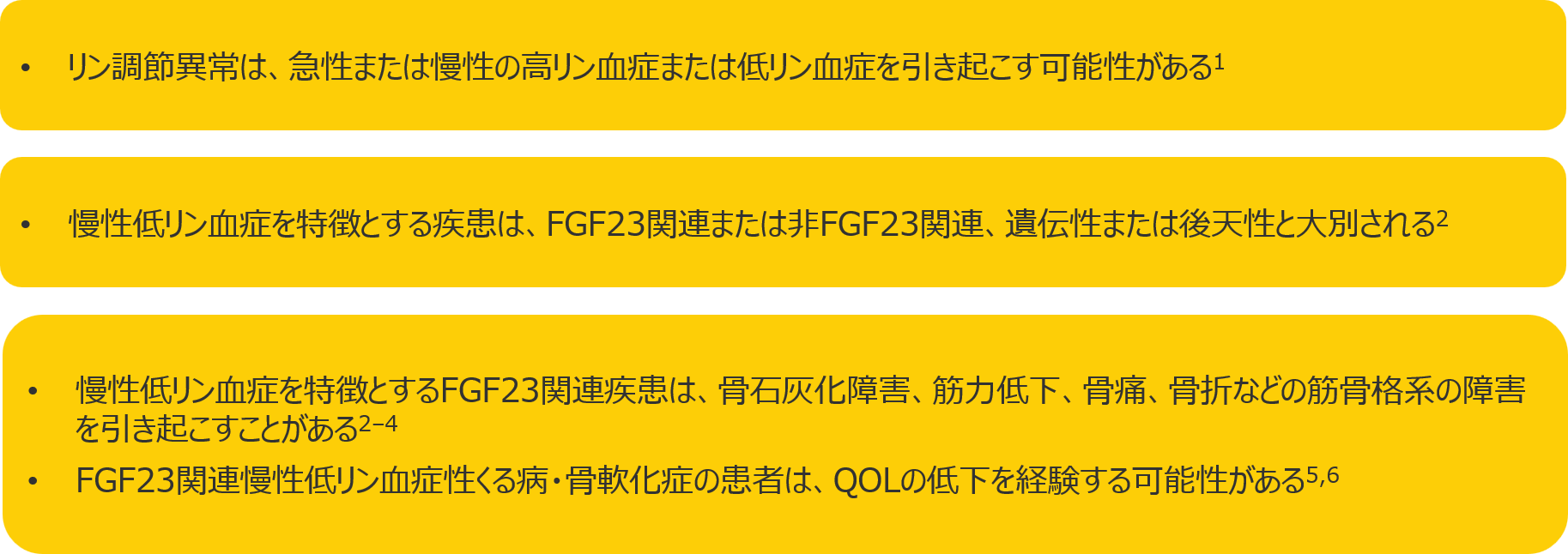
- FGF23, fibroblast growth factor 23.
- 1. Koumakis E, et al. Calcif Tissue Int. 2021;108:41-73. 2. Florenzano P, et al. Lancet Diabetes Endocrinol. 2020;8:163-74. 3. Beck-Nielsen SS, et al. Orphanet J Rare Dis. 2019;14:58-82. 4. Minisola S, et al. Nat Rev Dis Primers. 2017;3:17044. 5. Skrinar A, et al. J Endocrine Soc. 2019;3:1321-34. 6. Jan de Beur, SM, et al. J Bone Miner Res. 2020;36:627-35.
References
- Amarnani R, et al. Novel use of burosumab in refractory iron-induced FGF23-mediated hypophosphataemic osteomalacia. Rheumatol. 2020;59:2166-8.
- Beck-Nielsen SS, et al. FGF23 and its role in X-linked hyphophosphataemia-related morbidity. Orphanet J Rare Dis. 2019;14:58-82.
- Carpenter TO, et al. A clinician's guide to X-linked hyphophosphataemia. J Bone Miner Res. 2011;26:1381-8.
- Che H, et al. Impaired quality of life in adults with X-linked hyphophosphataemia and skeletal symptoms. Eur J Endocrinol. 2016;174:325-33.
- Chesher D, et al. Outcome of adult patients with X-linked hypophosphatemia caused by PHEX gene mutations. J Inherit Metab Dis. 2018;41:865-76.
- Chong WH, et al. Tumor-induced osteomalacia. Endocr Relat Cancer. 2011;18:R53-R77.
- Chong WH, et al. Tumor localization and biochemical response to cure in tumor-induced osteomalacia. J Bone Miner Res. 2013;28:1386-98.
- Davies M, et al. Impaired hearing in X-linked hypophosphataemic (vitamin-D-resistant) osteomalacia. Ann Intern Med. 1984;100:230-2.
- Dixon PH, et al. Mutational analysis of PHEX gene in X-linked hypophosphatemia. J Clin Endocrinol Metab. 1998;83:3615-23.
- Evans DJ, Azzopardi JG. Distinctive tumours of bone and soft tissue causing acquired vitamin-D-resistant osteomalacia. Lancet. 1972;1:353-4.
- Feng J, et al. The diagnostic dilemma of tumor induced osteomalacia: a retrospective analysis of 144 cases. Endocr J. 2017;64:675-83.
- Ferizović N, et al. Exploring the burden of X-linked hypophosphataemia: an opportunistic qualitative study of patient statements generated during a technology appraisal. Adv Ther. 2020;37:770-84.
- Florenzano P, et al. Approach to patients with hypophosphataemia. Lancet Diabetes Endocrinol. 2020;8:163-74.
- Florenzano P, et al. Tumor-induced osteomalacia. Bone Rep. 2017;7:90-7.
- Florenzano P, et al. Tumor-induced osteomalacia. Calcif Tissue Int. 2020;108:128-42.
- Folpe AL, et al. Most osteomalacia-associated mesenchymal tumors are a single histopathologic entity: an analysis of 32 cases and a comprehensive review of the literature. Am J Surg Pathol. 2004;28:1-30.
- Foster BL, et al. The rachitic tooth. Endocr Rev. 2014;35:1-34.
- Fukumoto S, et al. Pathogenesis and diagnostic criteria for rickets and osteomalacia - proposal by an expert panel supported by Ministry of Health, Labour and Welfare, Japan, The Japanese Society for Bone and Mineral Research and The Japan Endocrine Society. Endocr J. 2015;62:665-71.
- Gjorup H, et al. Oral health-related quality of life in X-linked hypophosphataemia and osteogenesis imperfecta. J Oral Rehab. 2021;48:160-8.
- Glaspy JA, et al. hyphophosphataemia associated with intravenous iron therapies for iron deficiency anemia: a systematic literature review. Ther Clin Risk Manag. 2020;16:245-59.
- Haffner D, et al. Clinical practice recommendations for the diagnosis and management of X-linked hypophosphataemia. Nat Rev Nephrol. 2019;15:435-55.
- Hawley S, et al. Prevalence and Mortality of Individuals With X-Linked Hypophosphatemia: A United Kingdom Real-World Data Analysis. J Clin Endocrinol Metab. 2020;105:e871-e878.
- Hu F, et al. Quantitative ELISA-like immunohistochemistry of fibroblast growth factor 23 in diagnosis of tumor-induced osteomalacia and clinical characteristics of the disease. Dis Markers. 2016;2016:3176978.
- Hu F-K, et al. Tumor-induced osteomalacia with elevated fibroblast growth factor 23: a case of phosphaturic mesenchymal tumor mixed with connective tissue variants and review of the literature. Chin J Cancer. 2011;30:794-804.
- Imel A. Enthesopathy, Osteoarthritis, and Mobility in X-linked Hypophosphatemia. J Clin Endocrinol Metab. 2020;105:e2649-51.
- Jan de Beur SM. Tumor-induced osteomalacia. JAMA. 2005;294:1260-7.
- Jerkovich F, et al. Burden of disease in patients with tumor-induced osteomalacia. JBMR Plus. 2021;5:e10436.
- Jiang Y et al. Tumor-induced osteomalacia: an important cause of adult-onset hyphophosphataemic osteomalacia in China: Report of 39 cases and review of the literature. J Bone Miner Res. 2012;27:1967-75.
- Kalantar-Zadeh K, et al. Parenteral iron therapy and phosphorus homeostasis: A review. Am J Hematol. 2021;96:606-16.
- Karaplis AC, et al. Mineralizing enthesopathy is a common feature of renal phosphate-wasting disorders attributed to FGF23 and is exacerbated by standard therapy in hyp mice. Endocrinology. 2012;153:5906-17.
- Kassianides X, Bhandari S. Hypophosphataemia, fibroblast growth factor 23 and third-generation intravenous iron compounds: a narrative review. Drugs Context. 2021;10:2020-11-3.
- Koumakis E, et al. The Causes of Hypo- and Hyperphosphatemia in Humans. Calcif Tissue Int. 2021;108:41-73.
- Liamis G, et al. Medication-induced hypophosphatemia: a review. Q J Med. 2010; 103:449-59.
- Liang G, et al. An atypical degenerative osteoarthropathy in Hyp mice is characterized by a loss in the mineralized zone of articular cartilage. Calcif Tissue Int. 2011;89:151-62.
- Linglart A, et al. Therapeutic management of hyphophosphataemic rickets from infancy to adulthood. Endocr Connect. 2014;3:R13-30.
- Lo SH, et al. Exploring the burden of X-linked hyphophosphataemia: a European multi-country qualitative study. Qual Life Res. 2020;29:1883-93.
- Mao M, et al. Growth curves for children with X-linked hyphophosphataemia. J Clin Endocrinol Metab. 2020;105:3243-9.
- Martin A, et al. Regulation and function of the FGF23/klotho endocrine pathways. Physiol Rev. 2012;92;131-55.
- Minisola S, et al. Tumour-induced osteomalacia. Nat Rev Dis Primers. 2017;3:17044.
- Oyama N, et al. Malignant transformation of phosphaturic mesenchymal tumor: a case report and literature review. Clin Ped Endocrinol. 2020;29:69-75.
- Pantel G, et al. Hearing loss and fluctuating hearing levels in X-linked hypophosphataemic osteomalacia. J Laryngol Otol. 2009;123:136-40.
- Quarles LD. Endocrine functions of bone in mineral metabolism regulation. J Clin Invest. 2008;118:3820-8.
- Ruppe MD. X-Linked hyphophosphataemia. In: GeneReviews® [Internet]. Seattle (WA): University of Washington, Seattle; 1993-2020. Available at: http://www.ncbi.nlm.nih.gov/books/NBK83985/. Accessed: June 2026.
- Skrinar A, et al. The lifelong impact of X-linked hyphophosphataemia: results from a burden of disease survey. J Endocrine Soc. 2019;3:1321-34.
- Steele A et al. Osteoarthritis, Osteophytes, and Enthesophytes Affect Biomechanical Function in Adults With X-linked Hypophosphatemia. J Clin Endocrinol Metab. 2020;105:e1798-814.
- US National Library of Medicine. Available at: https://ghr.nlm.nih.gov/primer/inheritance/inheritancepatterns. Accessed: June 2026.
- Weber TJ, et al. Serum FGF23 levels in normal and disordered phosphorus homeostasis. J Bone Miner Res. 2003;18:1227-34.
- Yamada Y, et al. Histopathological and genetic review of phosphaturic mesenchymal tumours, mixed connective tissue variant. Histopathology. 2018;72:460-71.
Module 3
リンの調節機構の破綻を主訴とする疾患
Module3のPDFをダウンロード